The GE Aerospace Derecho hypersonic program just cleared its first real hurdle toward actually flying. The U.S. Defense Innovation Unit has awarded GE Aerospace a contract to move its Mach 5 dual-mode ramjet demonstrator, code-named Derecho, into full integration and initial testing — the step that comes right before a real aircraft leaves the ground.
The award falls under the Pentagon’s Hypersonic and High-Cadence Airborne Testing Capabilities program, known as HyCAT, which exists because the U.S. hypersonics community has a testing problem: building test vehicles has historically been slower and more expensive than the engineering they’re meant to validate.
Derecho is targeted for its first flight test in 2028, and it would be GE Aerospace’s first time putting its ramjet technology in the air rather than on a test stand.
Table of Contents
GE Aerospace Derecho Hypersonic Program Explained
Derecho takes its name from a Spanish word for a long-lived, fast-moving windstorm. Fitting, since the vehicle itself is built around going fast for a sustained stretch rather than in a single quick burst.
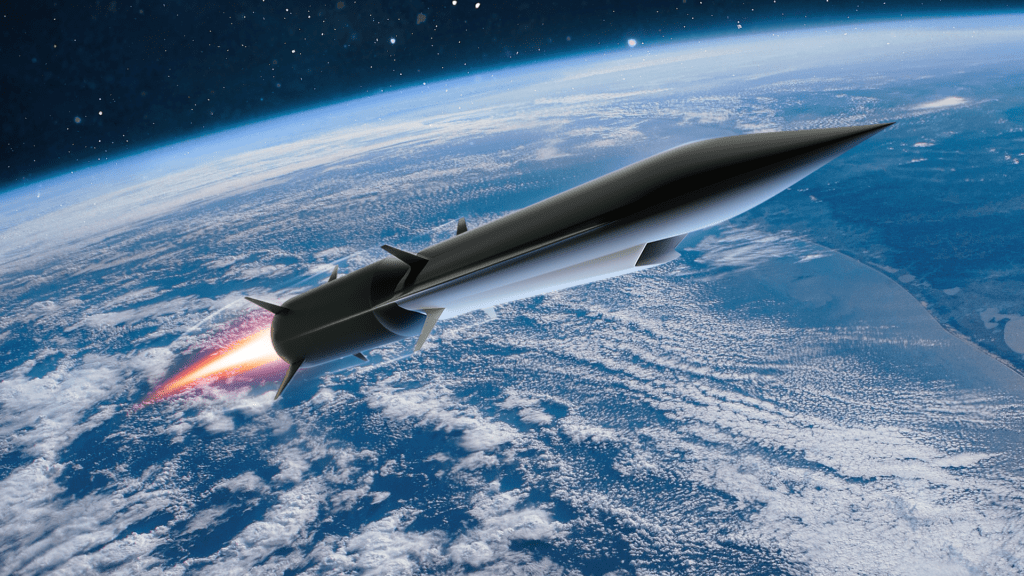
The system GE Aerospace is building is an all-up round: a booster paired with a cruiser, designed and tested together as one complete unit rather than validated piece by piece.
The cruiser is the part that matters most. It carries an air-breathing, dual-mode ramjet engine designed to sustain flight at roughly Mach 5, or about 3,800 miles per hour.
Combining the booster and cruiser into a single testable system is deliberate. It lets engineers validate how the whole vehicle behaves together in actual flight, instead of only proving that individual components work in isolation on a test stand.
The Engine Problem Derecho Is Built to Solve
Hypersonic propulsion has a gap in the middle of it, and that gap is exactly what a dual-mode ramjet is built to close.
A conventional ramjet works by using the vehicle’s own forward motion to compress incoming air for combustion, with no moving turbine parts. That makes it simple and lightweight, but it loses efficiency as speed climbs into the truly hypersonic range.
A scramjet, the engine most associated with hypersonic flight, is efficient at very high speed but has the opposite problem: it cannot even ignite until the vehicle is already moving fast, generally above Mach 3.
That leaves a hole. Something has to get a vehicle up to the speed a scramjet needs before the scramjet can do any useful work, and that something has traditionally been a separate rocket booster, adding weight, complexity, and cost.
The GE Aerospace Derecho engine is engineered to operate continuously across both regimes in a single unit, smoothing over that handoff instead of requiring two entirely different propulsion systems bolted together.
“Acceleration in this type of hypersonic testing is critical to closing the gap between where we are today and where the technology needs to be.”
Steve “Doogie” Russell, Vice President and General Manager, Edison Works, GE Aerospace
GE Aerospace’s approach to making that dual-mode operation work relies on a technology called rotating detonation combustion, which ignites fuel through a continuously traveling detonation wave rather than the steady, controlled burn used in a conventional jet engine. The company says the technique allows higher thrust from a smaller, lighter engine.
How GE Got Here: Three Years of Ground Testing
The HyCAT award is not GE Aerospace’s first step into hypersonics. It is the payoff of a program that has been building since 2023, when the company completed initial concept development of its dual-mode ramjet.
- December 2023: GE Aerospace demonstrated what it called a world-first rig test combining a dual-mode ramjet with rotating detonation combustion in a supersonic flow stream, at its research center in Niskayuna, New York
- 2024: Subsystem refinement and evaluation continued, including a subscale prototype called the 3X, rated at 3,000 pounds of thrust, tested at GE’s Edison Works facility in Evendale, Ohio
- 2025: The program advanced into preliminary design review of the full all-up round vehicle
- 2026: The newly awarded HyCAT phase moves the program into full integration of the all-up round, along with qualification and component-level testing of key subsystems
Much of that groundwork traces back to Innoveering, a Long Island-based hypersonic propulsion specialist GE Aerospace acquired in 2022. Innoveering’s existing dual-mode ramjet design became the foundation GE built on, combined with the company’s own decade-plus of work on rotating detonation combustion and a much longer history of turbine engine development generally.
Why the Pentagon Needs a Cheaper Way to Test Hypersonics
HyCAT exists because hypersonic testing has a supply problem. The Defense Innovation Unit launched the program in 2023 specifically to develop lower-cost, higher-frequency airborne platforms for testing hypersonic technology, sensors, and guidance systems.
Air-breathing hypersonic vehicles are difficult to test by nature. Sustaining flight at Mach 5 and beyond means sustained exposure to extreme aerodynamic heating, and every test flight has historically been expensive enough that programs could only afford a handful of attempts.
That scarcity slows everything down, because engineers learn the most from failures, and a program that can only fly once or twice a year does not get to fail and iterate quickly.
The goal behind HyCAT is to flip that equation: cheaper, more frequent flights that let the entire U.S. hypersonics community, not just one program, gather real flight data faster than the traditional model allows.
Not the Only Team on the Program
GE Aerospace is one of several companies the Defense Innovation Unit has brought into HyCAT, each pursuing a different technical approach to the same underlying testing problem.
Hermeus Corporation is developing turbine-based combined cycle propulsion aimed at a reusable hypersonic aircraft. Australia’s Hypersonix has already flown under the program: its hydrogen-fueled SPARTAN scramjet vehicle, DART AE, achieved sustained flight above Mach 5 on February 27, 2026, launching from Wallops Island, Virginia, aboard Rocket Lab’s HASTE vehicle.
That made Hypersonix the first HyCAT contractor to actually get a vehicle in the air. GE Aerospace’s own hypersonics subsidiary, Innoveering, separately holds a HyCAT contract for an air-launched, air-breathing testbed, developed with subcontractors Specter Aerospace and Starfighters International.
“Accessing the commercial and non-traditional ecosystem is a key enabler to accelerating progress in the hypersonics community of interest, particularly for closing mission timelines and driving towards mass and affordability.”
Lt. Col. Nicholas Estep, Emerging Technologies Portfolio Director, Defense Innovation Unit
That is the same commercial-partner logic behind GE Aerospace’s own involvement, and Hypersonix’s successful flight is the clearest evidence yet that the approach is producing real results rather than just faster paperwork.
That spread of approaches is intentional. Rather than betting the entire program on one propulsion concept, the Defense Innovation Unit is running several in parallel, and Derecho’s dual-mode ramjet is GE Aerospace’s specific bet in that wider field.
Similar logic is playing out elsewhere in the Pentagon’s weapons portfolio, where programs like the Navy’s proposed Silent Anvil torpedo are also wrestling with how to field new propulsion and standoff concepts faster than the traditional acquisition cycle allows. The GE Aerospace Derecho program is the propulsion-testing version of that same pressure.
FAQ: GE Aerospace Derecho Hypersonic Program
What is a dual-mode ramjet?
It is an air-breathing engine designed to operate as a conventional ramjet at lower supersonic speeds and transition to scramjet-like operation at higher hypersonic speeds, all within a single engine. GE Aerospace’s version uses rotating detonation combustion to help make that transition work.
When will Derecho actually fly?
GE Aerospace and the Defense Innovation Unit are targeting a first flight test for the GE Aerospace Derecho vehicle in 2028. The newly awarded contract phase covers full integration and initial qualification testing, the stage that comes before that flight.
Is Derecho a weapon?
No. Derecho is a flight-test demonstrator built to prove out dual-mode ramjet propulsion technology, not a fielded weapon system. The propulsion knowledge it generates could eventually feed into future hypersonic aircraft or weapons programs, but Derecho itself is a research and testing vehicle.
Looking Ahead
The next two years will be almost entirely invisible to the public for the GE Aerospace Derecho program. Full integration, subsystem qualification, and component testing are not the kind of milestones that generate dramatic footage, and GE Aerospace has not indicated when it will next share a public update.
The moment worth watching for is 2028, when Derecho is set to attempt what none of GE Aerospace’s ground rig tests, however successful, can actually prove: that a dual-mode ramjet works the same way in the air as it does on a test stand. Everything since 2023 has been building toward answering that one question.
The Aviation Diary will continue tracking the GE Aerospace Derecho hypersonic program, the Defense Innovation Unit’s HyCAT initiative, and U.S. hypersonic propulsion development generally.
Source
- Aviation Week — GE Aerospace Boosts Hypersonic Hopes With HyCAT Win
- Aerospace Testing International
- GE Aerospace — Hypersonics program overview
- FlightGlobal
- Hypersonix Launch Systems — HyCAT mission page
- U.S. Defense Innovation Unit — HyCAT program update