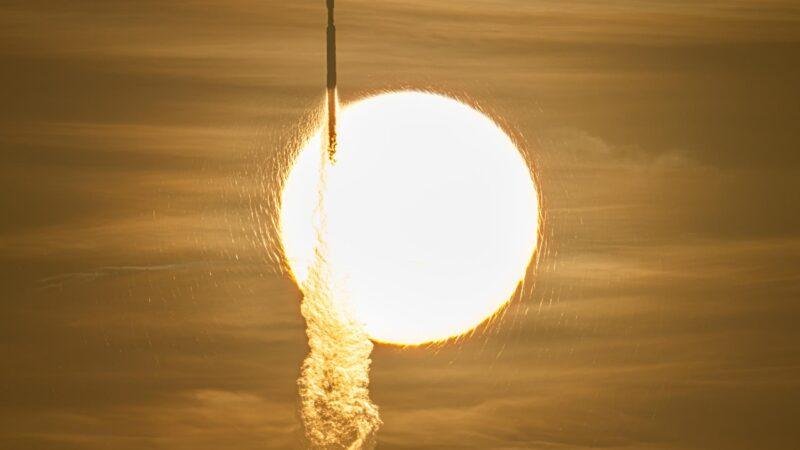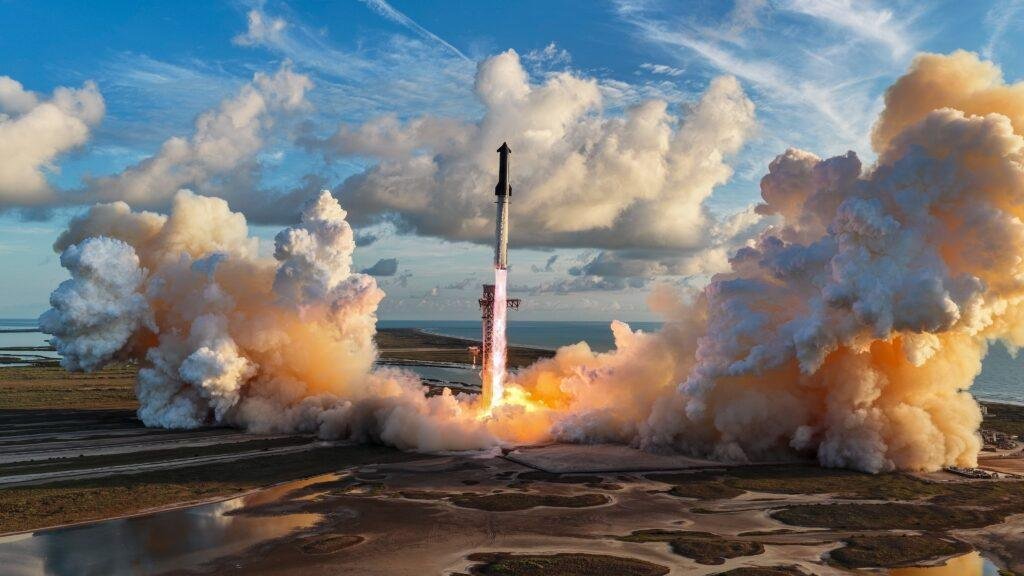
Starship Flight 14 put SpaceX’s rocket into orbit for the first time on Sept. 28, 2026, releasing 26 Starlink V3 satellites before the ship splashed down in the northern Pacific Ocean.
Starship Flight 14 did not go entirely to plan. One of the ship’s Raptor vacuum engines shut down early during ascent, and controllers ended a mission planned for nearly 10 hours and six orbits after about three hours.
Orbit is the line Starship had to cross before it could carry operational payloads. The 13 earlier flights were suborbital, and the satellites released on Flight 14 are the first operational Starlink V3 spacecraft SpaceX has flown.
Table of Contents
Table of Contents
Starship Reaches Orbit on Its 14th Flight
Starship Flight 14 lifted off from Starbase, Texas, at 7:48:59 a.m. Central Time, according to SpacePolicyOnline. The Super Heavy booster lost one of its 33 engines shortly after liftoff, which did not affect its performance. SpaceX did not attempt a tower catch of the booster, something it has not tried since Flight 8, and the booster instead made a soft landing in the Gulf.
Earlier test flights flew suborbital paths toward the Indian Ocean. Starship Flight 14 was the first to put the upper stage into Earth orbit, on a profile that called for an altitude of roughly 170 miles (275 kilometers) and about six trips around the planet, Astronomy magazine reported.
An Engine Shutdown Shortened the Mission
SpaceX said a single Raptor vacuum engine on the ship shut down early during the ascent burn, and that the ship stayed on its planned, passively safe trajectory by firing its remaining engines longer.
That left a decision. SpaceX could commit to an orbital insertion burn or keep the ship suborbital and land it in the Indian Ocean, as on earlier flights. SpacePolicyOnline reported that SpaceX’s webcast host was explaining the Indian Ocean plan when new information arrived and the team reviewed the call. SpaceX then chose orbit.
The ship relit a single Raptor sea-level engine for the orbit insertion burn. SpaceX said the flight control team then limited the time on orbit out of caution because of the engine issue, and the ship performed its first deorbit burn toward a splashdown area in the northern Pacific. It relit all three sea-level engines for a landing burn and flip maneuver and splashed down on target.
Starship Flight 14 lasted about 3 hours 8 minutes, SpacePolicyOnline reported, against a plan of almost 10 hours that would have ended in the south Pacific west of Chile. The sources reviewed for this article do not give a root cause for the early engine shutdown.
26 Starlink V3 Satellites Deployed
On Starship Flight 14, the ship opened its payload bay door and released all 26 Starlink V3 satellites within about 30 minutes, and SpaceX established contact with each one, SpacePolicyOnline reported. Earlier flights also released V3 satellites as tests, but those were on the same suborbital path as the ship and reentered.
SpacePolicyOnline, citing Starlink, reported that V3 satellites carry 10 times the downlink capacity and 22 times the uplink capacity of the V2 generation.
Why Orbit Matters for NASA’s Artemis Plans
SpaceX is under contract to NASA to build a Human Landing System version of Starship to carry astronauts between lunar orbit and the Moon’s surface. That version depends on cryogenic refueling at an Earth-orbit fuel depot that has not been built, and SpaceX has not officially said how many launches it would take to fill one. A SpaceX official gave a rough guess of about 10 in January 2024.
NASA Administrator Jared Isaacman congratulated SpaceX after Starship Flight 14 and said the agency wants to help make Starship missions routine.
Artemis III, planned for next summer, is now an Earth-orbit test of rendezvous and docking with Starship and Blue Origin’s Blue Moon Mk2 lander, and SpacePolicyOnline reported that it does not require in-orbit refueling.
FAQ: Starship Flight 14
Did Starship reach orbit on Flight 14?
Yes. Starship Flight 14 was the first time a Starship reached orbit. All 13 earlier flights were suborbital.
Why did Flight 14 end early?
SpaceX said controllers limited the time on orbit out of caution after a Raptor vacuum engine shut down early during ascent. The ship deorbited after about three hours instead of the planned near-10-hour flight.
What did Starship deploy?
It released 26 Starlink V3 satellites, the first operational satellites of that generation.
Looking Ahead
The first thing to watch is whether SpaceX explains why the vacuum engine shut down, since that decided how long the ship stayed in orbit. Launch trackers list Starship Flight 15 as targeting October, but no date has been confirmed. Further out are the in-orbit refueling demonstration NASA’s lander plans depend on and the Artemis III docking test planned for next summer.
Sources
- SpacePolicyOnline — Starship Achieves Orbit for the First Time
- SpaceX on X — Starlink V3 deployment begins (Sept. 28, 2026)
- SpaceX on X — Splashdown confirmed (Sept. 28, 2026)
- SpaceX on X — Starship’s first orbital flight delivered 26 Starlink V3 satellites (Oct. 2, 2026)
- SpaceX on X — Hot-staging on Starship Flight 14 (Oct. 2, 2026)
- SpaceX Flight 14 summary, as quoted on X
- Astronomy — Starship reaches orbit on 14th test flight
- Satellite Today — Starship reaches orbit, cuts 10-hour mission short
- NASA Administrator Jared Isaacman on X — Congratulations to SpaceX
- Next Spaceflight — Launch schedule