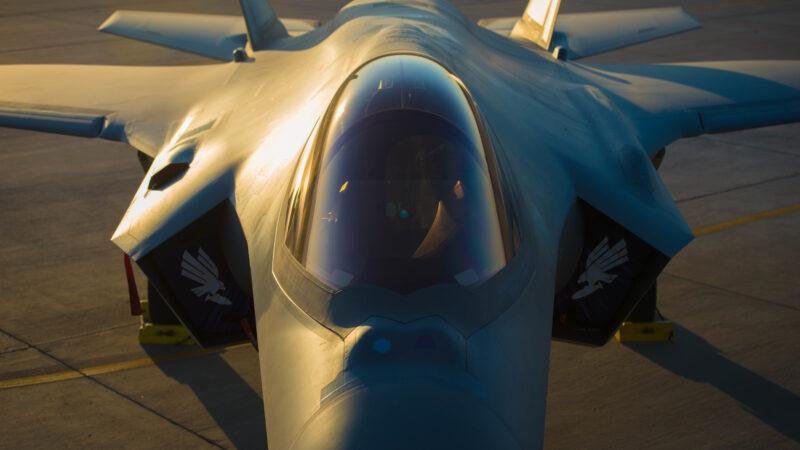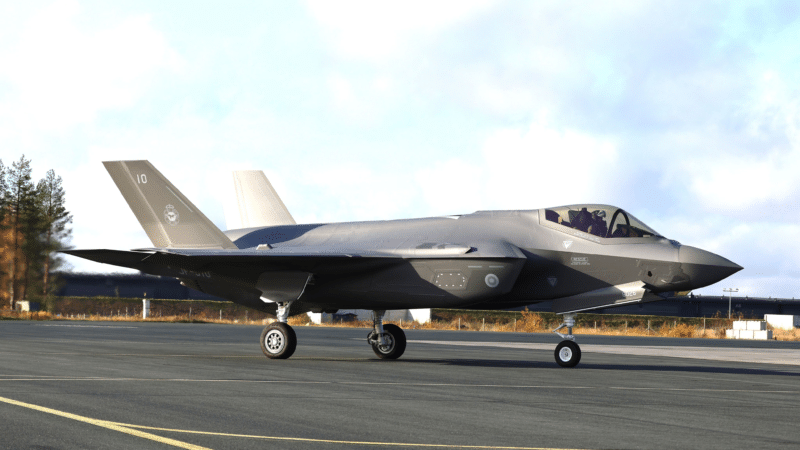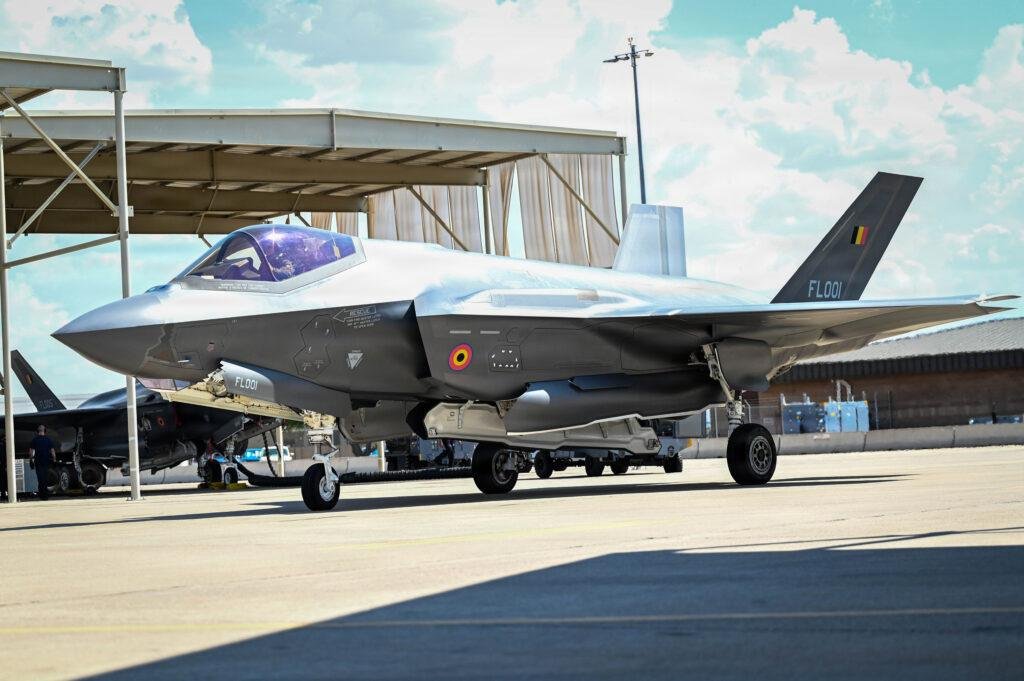
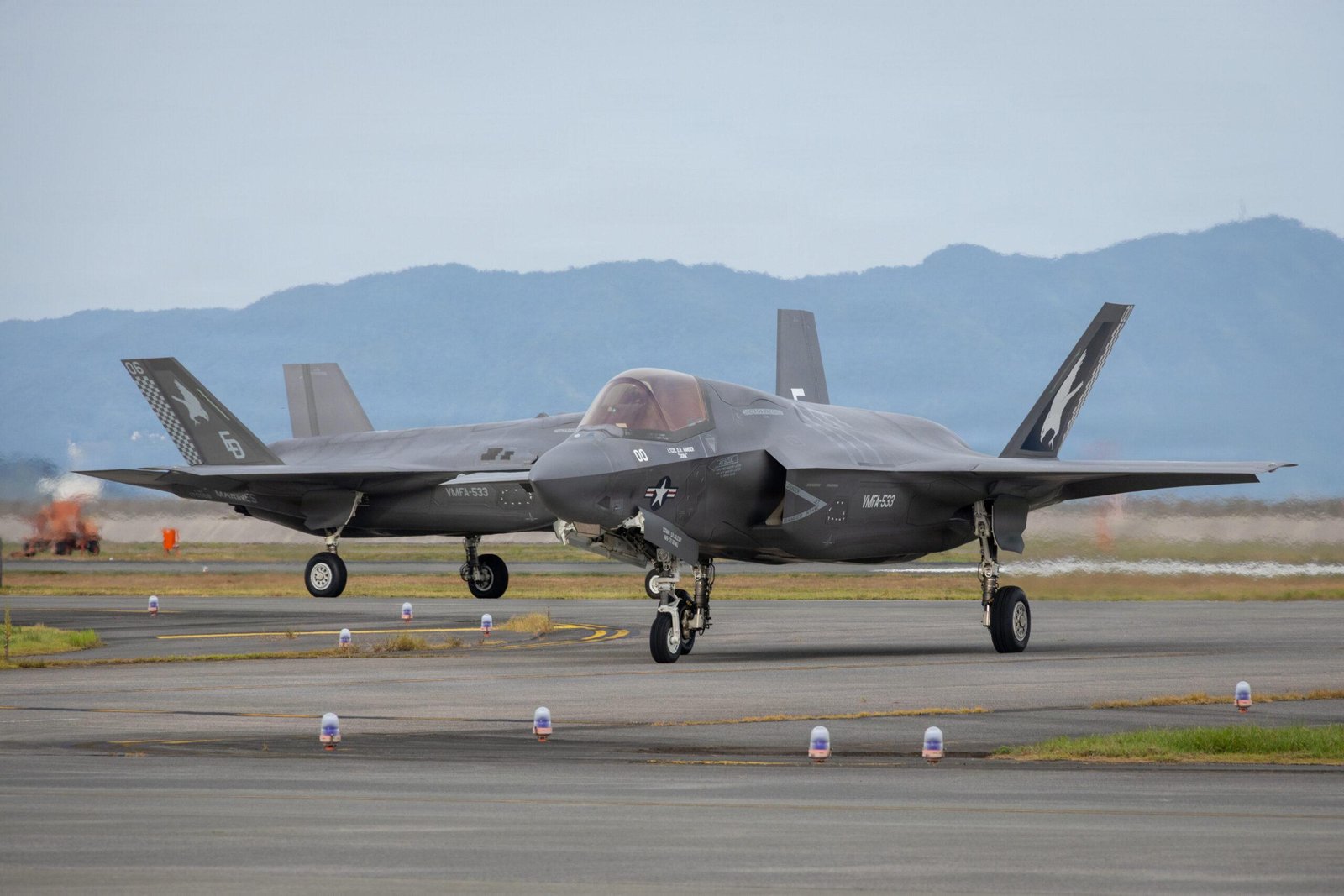
The Pentagon plans to equip the F-35 Lightning II with F-35 Starshield SATCOM, a satellite-based Beyond Line of Sight communications capability built on SpaceX’s secure Starshield constellation, according to the FY2027 F-35 Modernized Selected Acquisition Report dated April 21, 2026. The upgrade, targeted for fielding by September 2031, would let F-35s pass targeting and track data across distances well beyond the range of conventional radio links.
The report frames the addition as a step toward strengthening the F-35’s role in long-range kill chains — engagements where a sensor aircraft, a shooter and a command node may be separated by hundreds of miles and need a reliable way to share targeting data across that distance.
Table of Contents
What the Acquisition Report Actually Says
The new capability appears in the report’s Block 4 modernization roadmap under the designation Beyond Line of Sight Phase 0 (SATCOM). It’s built around the Protected Tactical Waveform, a secure communications standard the Pentagon uses across multiple satellite architectures, and is planned to operate in both Ku band (12 to 18 GHz) and Ka band (26.5 to 40 GHz).
The report identifies BLOS Phase 0 as an aircraft-level modernization rather than assigning it to a specific F-35 variant, so it isn’t yet clear whether F-35As, F-35Bs, F-35Cs, or all three will receive the upgrade first. Its initial function will be limited to passing track data — the location and movement information the jet’s sensors generate — over satellite links, rather than full two-way communications.
A Staged Rollout, Not a Single Upgrade
The Starshield-enabled satellite link is one piece of a broader, multi-year plan to expand the F-35’s beyond-line-of-sight communications. A 2026 UHF receiver capability provides an earlier, more limited means of receiving BLOS track information. Phase 0, targeted for September 2031, adds the satellite-based track-data transmission described in the acquisition report. A later Phase 1b is planned to expand the system to two-way video, and Phase 2, targeted for 2035, is intended to add voice communications over the same satellite architecture.
That sequencing means the fighter’s satellite communications will grow more capable in stages over roughly a decade, rather than arriving all at once — track data first, then imagery, then voice.
What Starshield Actually Is
Starshield is SpaceX’s purpose-built government version of its Starlink low-Earth-orbit satellite constellation, first announced in December 2022. Rather than the consumer broadband service Starlink provides, Starshield is designed for government customers and adds capabilities such as target tracking, optical and radio reconnaissance and early missile warning, alongside secure communications. Its primary customers include the Space Development Agency, the National Reconnaissance Office and the U.S. Space Force, and by 2025 at least 183 Starshield satellites had been launched.
The Space Force has been expanding protected tactical satellite communications more broadly at the same time, building out both government and commercial satellite architectures around the same Protected Tactical Waveform the F-35 upgrade will use — meaning the F-35’s Starshield link is one piece of a wider push across the Pentagon, not a standalone program built specifically for one aircraft.
The F-35 Joins a Broader Military Shift
The F-35 is far from the only platform the Pentagon has been connecting to Starlink and Starshield. Air Force Special Operations Command has been exploring ruggedized Starlink/Starshield terminals for its AC-130J Ghostrider gunships to improve beyond-line-of-sight communications supporting close air support and armed reconnaissance missions. Separately, Phoenix Air Group installed a government-focused Starshield terminal on a Learjet 35/36 in 2025, the first such installation on that airframe, with FAA approval already secured for the system.
Taken together, these programs point to Starshield becoming a common communications backbone across a range of military aircraft types rather than a one-off addition to any single platform.

FAQ: F-35 Starshield SATCOM
What does BLOS actually mean?
Beyond Line of Sight — communications that don’t require a direct, unobstructed path between two points, unlike conventional radio, which loses connectivity beyond the horizon or behind terrain. Satellite links are the most common way to achieve BLOS communications.
Which F-35 variant gets this first?
The acquisition report doesn’t specify. It describes BLOS Phase 0 as an aircraft-level modernization rather than assigning it to the F-35A, F-35B or F-35C specifically.
Is this the F-35’s first satellite communications capability?
No. A 2026 UHF receiver capability already provides an earlier, more limited means of receiving BLOS track data. The Starshield-enabled Phase 0 capability targeted for 2031 adds satellite-based transmission on top of that existing foundation.
Looking Ahead
Neither the Pentagon nor Lockheed Martin has released further technical detail on the F-35 Starshield SATCOM integration beyond what appears in the acquisition report. The Aviation Diary will continue tracking the F-35’s Block 4 modernization roadmap as the BLOS Phase 0 capability moves toward its 2031 fielding target.
Sources
- Army Recognition — U.S. to Equip F-35 Fighter Jets With Starshield Satellite Communications for Long-Range Kill Chains by 2031
- TheDefenseWatch — F-35 Starshield SATCOM Upgrade Targets Long Range Kill Chains
- RealClearDefense — U.S. to Equip F-35 Fighter Jets With Starshield SATCOM
- DefenseScoop — AFSOC Looks to Add Starlink Terminals to Ghostrider Gunships
- AIN — Phoenix Air Installs Government-Focused Starlink on Learjet
- Benton Institute — Starshield: The Military-Grade Starlink No One Is Talking About
- GDELT — Starshield Entity Reference