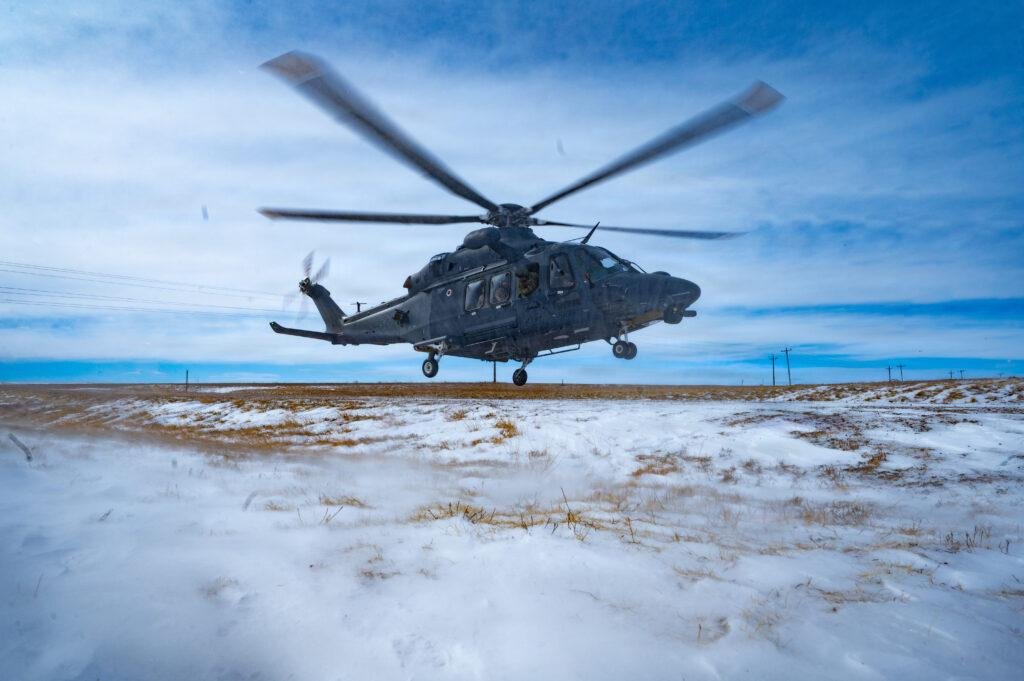
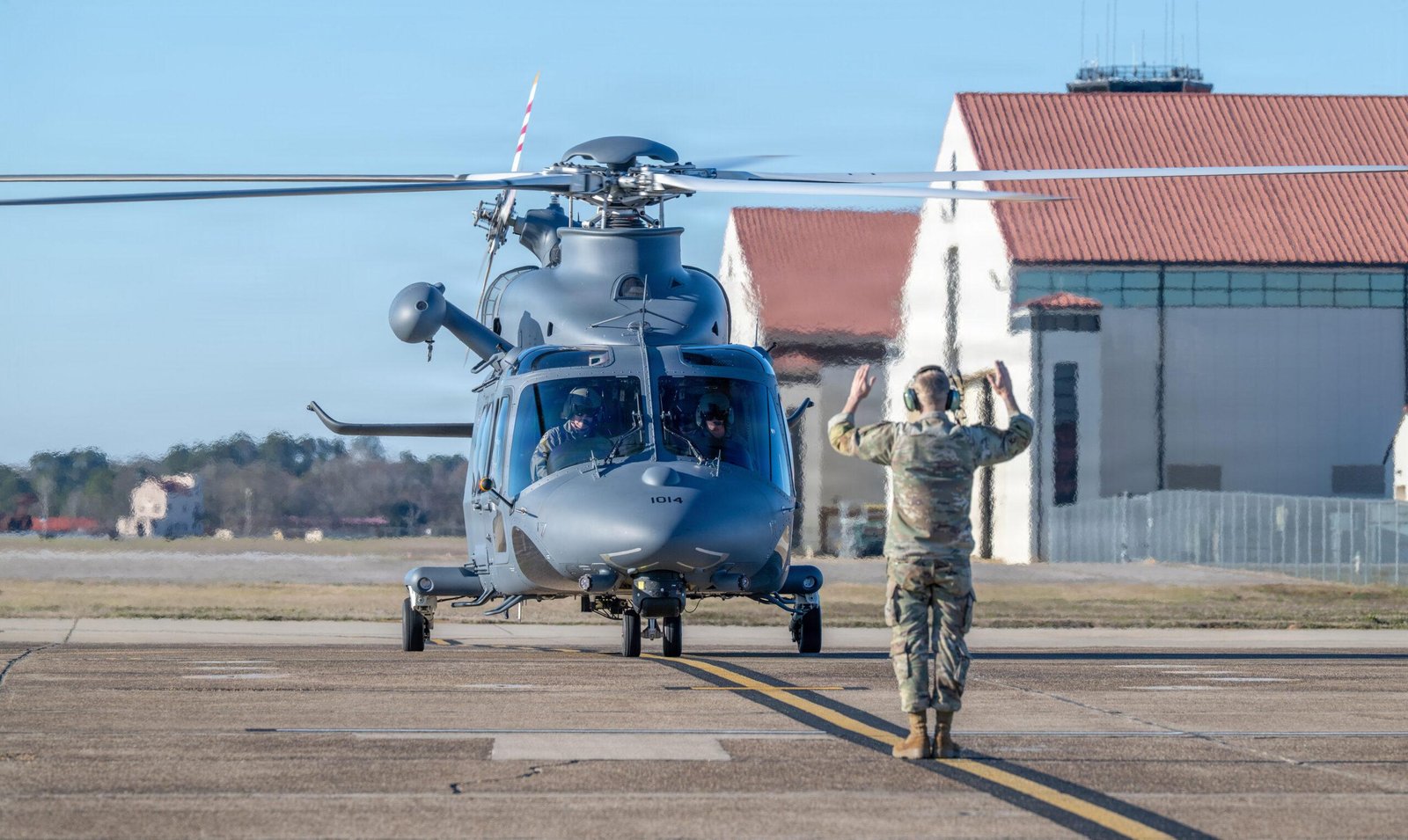
The MH-139 Grey Wolf has officially reached Initial Operational Capability, Air Force Global Strike Command announced August 31, marking the point where the Vietnam-era UH-1N Huey formally begins handing off nuclear missile-field security duty to a new aircraft.
The milestone took effect August 10 with the 40th Helicopter Squadron at Malmstrom Air Force Base, Montana, and comes years later than the Air Force originally planned when it awarded Boeing the contract back in 2018.
Table of Contents
MH-139 Grey Wolf Reaches IOC: What Changed on Aug. 10
Air Force Global Strike Command declared Initial Operational Capability for the MH-139A Grey Wolf as of August 10, with the announcement following on August 31. IOC means the aircraft can now be fielded and maintained by an operational unit, in this case the 40th Helicopter Squadron at Malmstrom Air Force Base.
The Grey Wolf’s mission is patrolling and escorting convoys around the sprawling intercontinental ballistic missile fields the Air Force’s 20th Air Force oversees, an area covering roughly 33,600 square miles of prairie, plains and mountains.
“For more than half a century, the UH-1N Huey has been a key element of our Intercontinental Ballistic Missile security, and we owe a debt of gratitude to the crews who flew and maintained it over all these years. Securing these missiles demands our best efforts and the MH-139 will significantly improve our capabilities.”
Gen. S.L. Davis, commander, Air Force Global Strike Command
The path to IOC included a first Initial Operational Test and Evaluation flight in January 2025, followed by the 40th Helicopter Squadron’s first operational mission that January: two Grey Wolves escorted a Minuteman III maintenance and security convoy more than 100 miles over six hours without needing to refuel.
Why the Grey Wolf Replaces the Huey
The UH-1N Huey has flown ICBM security missions since the early 1970s, and the Air Force’s fleet now averages more than 50 years old. Built on the civilian Leonardo AW139 airframe, the twin-engine MH-139 offers a substantial capability jump over the aircraft it’s replacing.
- Nearly 50% faster than the UH-1N Huey
- Carries roughly twice as many troops (15 passengers versus the Huey’s 6-13)
- Range of about 890 miles, nearly triple the Huey’s 300-plus miles
- Higher service ceiling and enhanced defensive systems
Those gains matter directly for the mission. Faster, longer-range helicopters mean tactical response forces can reach a convoy or missile site sooner across terrain that ranges from open prairie to mountains. The Air Force says the Grey Wolf also positions Global Strike Command to secure assets during the phased rollout of the LGM-35A Sentinel, the missile system set to eventually replace the Minuteman III.
A Program Years Behind Schedule
The Air Force awarded Boeing a $2.4 billion contract for the MH-139 in 2018, the service’s first time procuring a helicopter directly and Global Strike Command’s first major acquisition program. The first aircraft was delivered in December 2019, with an original goal of reaching IOC by 2021.
That timeline slipped by roughly five years. The program worked through FAA certification delays, a run of testing problems, and Pentagon concerns that the helicopter risked not meeting operational requirements. In 2024, the Air Force cut its planned fleet from 84 aircraft down to 42, all earmarked for ICBM security, but the smaller order drove per-unit costs up enough to trigger a “critical” cost breach under the Nunn-McCurdy Act and a formal notification to Congress.
The program has since regained ground. Congress included $210.3 million in the One Big Beautiful Bill Act, passed in July, to fund six additional MH-139s, and the Air Force’s fiscal 2026 budget raised its objective back up to 56 aircraft. House lawmakers have gone further, voting to authorize four more in their version of the 2027 defense policy bill, though that legislation is still well short of becoming law.
Which Bases Get the Grey Wolf Next
IOC at Malmstrom is the starting point, not the finish line. The 37th Helicopter Squadron at F.E. Warren Air Force Base, Wyoming, opened a new operations facility on August 14 to support the MH-139, setting the stage for Grey Wolves to begin arriving there in the coming weeks. After F.E. Warren, the 54th Helicopter Squadron at Minot Air Force Base, North Dakota, is next in line.
F.E. Warren has been in the news for a different reason this week: The Aviation Diary reported September 2 on the Air Force pulling AN/PRM-10 test kits from service after PCB contamination was confirmed at the base. That issue involves separate equipment and isn’t connected to the Grey Wolf rollout, but it underscores how much modernization activity is currently converging on the same ICBM wings.
Before any Grey Wolf reaches an operational squadron, its aircrews pass through the 908th Flying Training Wing at Maxwell Air Force Base, Alabama, the Department of Defense’s only formal training unit for the MH-139. The wing has been building out that training pipeline since its first Grey Wolf arrived in April 2024.
“It has been a distinct privilege to watch the iconic Huey faithfully support our global operations throughout my entire career. However, this transition represents a critical leap forward.”
Col. Bryant Bevan, commander, 582nd Helicopter Group
FAQ: MH-139 Grey Wolf
Does the MH-139 Grey Wolf replace the Huey at every base immediately?
No. IOC applies first to the 40th Helicopter Squadron at Malmstrom Air Force Base. F.E. Warren Air Force Base is next, with Grey Wolves expected in the coming weeks, followed by Minot Air Force Base’s 54th Helicopter Squadron.
Why did the MH-139 program take so long to reach IOC?
The program, originally targeting IOC by 2021, was delayed by FAA certification issues, testing problems, and a 2024 Nunn-McCurdy cost breach after the Air Force cut the planned fleet size. IOC was ultimately declared on August 10, 2026.
How many MH-139 Grey Wolf helicopters will the Air Force buy?
The Air Force’s current fiscal 2026 objective is 56 aircraft, up from a reduced 2024 plan of 42. The original program envisioned as many as 84. House lawmakers have proposed funding four more in a still-pending 2027 defense policy bill.
Looking Ahead
The next milestone to watch is the Grey Wolf’s arrival at F.E. Warren Air Force Base, expected within weeks of the 37th Helicopter Squadron’s new operations facility opening August 14. Minot Air Force Base follows after that. Congress’s still-pending 2027 defense policy bill, which would add four more aircraft to the program, is another marker worth tracking as the Air Force works toward its 56-aircraft objective.
Sources
- U.S. Air Force (official press release)
- Air & Space Forces Magazine
- Military Times
- AVweb
- DVIDS (908th welcomes first MH-139 Grey Wolf)