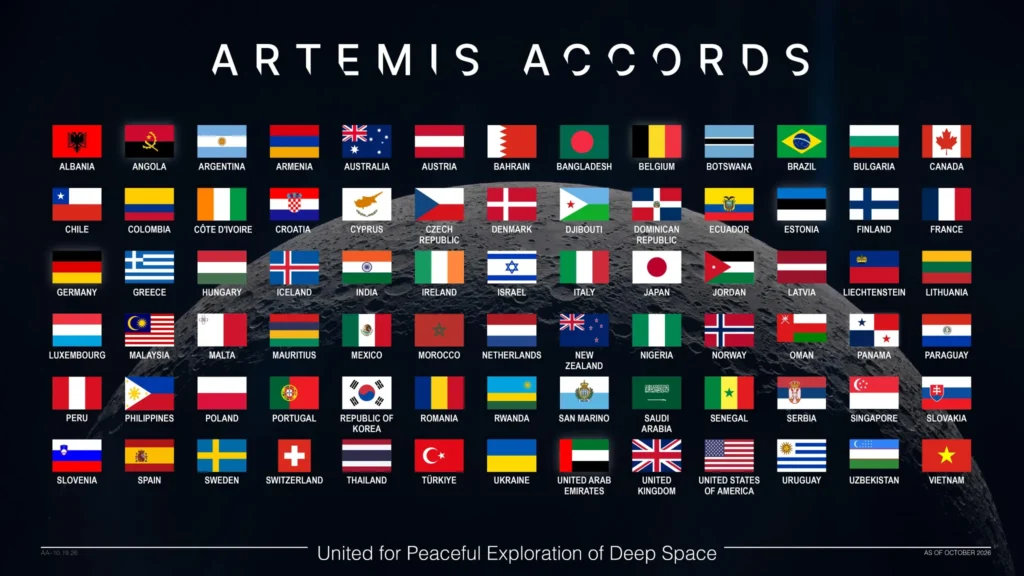
Vietnam Artemis Accords participation became official on October 28 when the country signed the international principles supported by NASA and its partners for peaceful, transparent space exploration. NASA identified Vietnam as the seventy-eighth nation to join the accords following a ceremony during Vietnam International Digital Week in Ha Long.
Minister of Science and Technology Vũ Hải Quân signed on behalf of Vietnam, while the U.S. ambassador participated in the event. The signature adds Vietnam to a diplomatic framework; it does not mean the country has launched a lunar spacecraft or received a funded seat on a specific Artemis mission.
Table of Contents
Vietnam Artemis Accords Signing in Ha Long
NASA describes the accords as principles intended to help governments coordinate exploration of the Moon and other destinations. Participants support peaceful activities, information exchange, assistance when needed and measures to avoid harmful interference among missions.
The arrangements grew from an initiative launched in 2020 by NASA and the U.S. State Department with seven other founding nations. The growing signatory count reflects diplomatic participation, not an equal number of operational lunar programs or spacecraft currently flying.
Vietnam’s signature came at a time when the country is developing its own technical and scientific programs. The event was a public international commitment, rather than a change to launch-vehicle licensing or an immediate order for a lunar lander.
The original announcement and its qualification details can be read in the primary source.
Vietnam’s Current Space Work and NASA Links
NASA cited cooperation with Vietnamese partners in satellite innovation, land research and radar-based Earth observation. It also pointed to recent work with the Vietnamese-German University supporting the Soil Moisture Active Passive mission, which measures soil conditions worldwide.
Vietnam has been developing national space facilities and Earth-observation capabilities, including the LOTUSat project. Radar imagery and satellite data can support weather information, land management and disaster response. These practical uses form part of the context for growing expertise in space systems.
Those existing programs should not be described as direct deliveries under the Artemis Accords. The October signature establishes shared principles for future cooperation but does not itself certify a radar satellite, complete a spaceport or guarantee funding.
For related reporting, see TAD’s earlier article, Artemis III Core Stage Joins Boosters for 2027 Flight Tests. That separate development provides context and should not be confused with the announcement reported here.
Principles Versus Mission Commitments
Signing the accords indicates support for peaceful uses, open scientific information and the preservation of significant heritage sites associated with exploration. It also promotes coordination intended to reduce interference where different activities may occupy nearby locations in space.
The framework does not turn the signatory country into a spacecraft supplier automatically. Participation, engineering contracts and mission assignments are separate decisions made through national budgets and specific partnerships. NASA has not announced a Vietnamese crew assignment in this release.
Vietnam’s addition broadens the geographic reach of the accords across Southeast Asia. Its significance is diplomatic and scientific, while any future technology missions will need their own verifiable schedules and technical announcements.
FAQ: Vietnam Artemis Accords
What are the Vietnam Artemis Accords?
Vietnam joined the international principles for peaceful and transparent civil space exploration.
How many nations have signed?
NASA counted Vietnam as the seventy-eighth signatory on October 28, 2026.
Did Vietnam sign up for a lunar landing?
No specific Vietnamese lunar landing mission or astronaut assignment was announced with the signature.
Looking Ahead
NASA expects additional countries to join the accords over time. For Vietnam, future collaboration projects would require separate announcements identifying their missions, funding and launch timelines.
Sources
Related profiles