The U.S. Navy has executed a $150 million modification to its existing Other Transaction agreement with Shield AI to advance X-BAT, the company’s AI-piloted, vertical takeoff and landing fighter, Shield AI announced on Oct. 8, 2026.
The funding comes from the Office of the Under Secretary of War for Acquisition and Sustainment through its Defense Exportability Features program, and Shield AI says it will invest $150 million of its own capital alongside it. Counting a separate $50 million government action in August and the $50 million of private capital the company independently committed alongside that action, Shield AI puts announced public and private commitments to X-BAT at $400 million.
Unlike the August action, the first publicly announced modification, which was tied to the Navy and Defense Innovation Unit’s runway-independent maritime strike (RIMES) effort, this second one is funded by a Pentagon program that pays for technology-protection features so U.S. systems can be sold to allies, as the company courts industrial partners in Poland and Greece.
What the $150 Million X-BAT Modification Covers
The award is not a new contract: Shield AI describes it as a change to an agreement the company already holds, and its release says the modification “supports Defense Exportability Features.”
Shield AI did not say which exportability features the money will pay for, how long the work will run, or how much of the $150 million has been obligated so far. TAD did not find a separate Navy or Department of War announcement of the modification, so the amount, the agreement type and the funding source in this story rest on Shield AI’s release.
What the Exportability Funding Is For
The Pentagon’s exportability work is governed by 10 U.S.C. 4067, which directs it to develop and incorporate technology protection features in systems designated by the Under Secretary for Acquisition and Sustainment, in order to increase ally and partner military capability or improve coalition interoperability. The law defines those features as the technical modifications needed to protect critical program information, including anti-tamper technologies.
The same law requires contracts for that design work on a designated system to include a cost-sharing provision under which the contractor bears half of the cost, or another share the Secretary considers appropriate upon a showing of good cause. Shield AI’s $150 million equals the government amount, but the company did not say whether the match was required, whether X-BAT is a designated system under the law, or whether its money goes to the exportability work or the wider program.
The company has been laying industrial groundwork abroad. On Sept. 8, Shield AI signed a letter of intent with Polish defense group PGZ and WZL-2, the Polish Air Force’s main aircraft depot, to partner on the design, production and delivery of X-BAT and on sustaining it in Poland. On Oct. 8, Shield AI announced a strategic agreement, signed in Athens, with Greek infrastructure group GEK TERNA to pursue parts production, aircraft integration and long-term sustainment in Greece. Neither is an aircraft order. Both announcements say specific roles and facilities will be set in definitive agreements that have yet to be concluded.
How the August RIMES Award Fits In
On Aug. 13, the Department of the Navy Rapid Capability Office and PAE Aviation, in partnership with the Defense Innovation Unit, announced a $50 million investment that expanded existing risk-reduction work with Shield AI on Runway Independent Maritime Expeditionary Strike, or RIMES, capabilities.
Shield AI describes RIMES as a Defense Innovation Unit project to give combatant commanders long-range strike aircraft that can take off and land vertically from ships, islands and austere sites without fixed runways. X-BAT is one component of that effort, according to the company.
What X-BAT Is Designed to Do
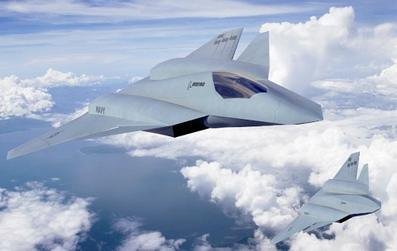
Shield AI unveiled X-BAT in October 2025. The company describes it as a low-observable, multirole strike fighter. According to Shield AI, it is designed to carry weapons up to the 2,000-pound class in internal bays comparable in size to the F-35’s, with an objective combat radius of 1,000 nautical miles. These are design goals, not demonstrated performance.
X-BAT is designed around GE Aerospace’s F110 engine and is to be flown by Shield AI’s Hivemind software, which the company says serves as the aircraft’s AI pilot in GPS-denied and communications-constrained conditions.
The company is pitching the aircraft directly at naval aviation. “Its runway-independent design and small deck footprint can increase sortie generation and extend long-range air combat power from CVNs, LHAs, LHDs and ESBs,” said J.J. “Yank” Cummings, Shield AI’s head of mission solutions for the U.S. Navy and a former commanding officer of the aircraft carrier USS Gerald R. Ford. Those designations refer to aircraft carriers, amphibious assault ships and expeditionary sea bases. Cummings said the company is “designing it for safe, high-tempo manned-unmanned flight deck operations and integration with the missions and capabilities of the carrier air wing.”
The Navy is weighing uncrewed combat aircraft on other fronts as well, including a surrogate Collaborative Combat Aircraft to build operational experience while its own CCA program develops.
Development Status Ahead of First Flight
Shield AI says a team of 500 engineers at the company and key suppliers, including GE Aerospace, is building flight-test aircraft. The team has completed engine light-off and integration of the thrust-vectoring nozzle that X-BAT needs for vertical flight, and has validated weapons bay aerodynamics in low- and high-speed wind-tunnel testing.
The nozzle is the Axisymmetric Vectoring Exhaust Nozzle, originally developed for a thrust-vectoring program that flew on an F-16 in the 1990s. GE Aerospace and Shield AI said in July that they had integrated it into an F110-GE-129E engine and completed light-off at GE Aerospace’s test site in Peebles, Ohio.
“We are testing early and often while working on the aircraft, mission systems, ship suitability and production in parallel,” said Armor Harris, Shield AI’s senior vice president of aircraft. “That approach helps us identify and resolve issues earlier, reduce development risk and move more quickly toward flight testing.”
Shield AI has also named its X-BAT sites: flight test and sustainment at Newton, Kansas, and production in Des Moines, Washington, with production planned to begin in 2029. Another autonomous combat jet is already flying: Northrop Grumman announced on Oct. 3 that its company-funded YFQ-48A had completed a first fully autonomous flight, as TAD reported in its coverage of the Talon Blue first flight.
FAQ: X-BAT Funding
Is the $150 million a new X-BAT contract?
No. Shield AI says it is a modification to the company’s existing Other Transaction agreement with the Navy, the same agreement modified in August for the RIMES work.
Who is paying for the X-BAT work?
The Navy executed the modification with funding from the acquisition and sustainment office’s Defense Exportability Features program, and Shield AI says it will add $150 million of its own capital.
Has X-BAT flown yet?
Not yet. Shield AI says X-BAT is scheduled to begin flight testing later in 2026.
Looking Ahead
The next milestone is the start of X-BAT flight testing, which Shield AI has scheduled for later this year. Beyond that, the company still has to turn its Polish and Greek agreements into definitive contracts, and it plans to begin production in 2029. How much of the new $150 million is spent, and on which export protections, has not been disclosed.
Sources
- Shield AI — Shield AI and U.S. government investment in X-BAT reaches $400 million (Oct. 8, 2026)
- DVIDS (PAE Aviation) — DON RCO, DIU and PAE Aviation invest $50M to scale unmanned maritime strike capabilities (Aug. 13, 2026)
- 10 U.S.C. 4067 — Technology protection features activities (Cornell LII)
- Shield AI — Shield AI and GE Aerospace light off X-BAT engine (July 20, 2026)
- Shield AI — Shield AI names Kansas and Washington the flight test and production homes of X-BAT (Sept. 30, 2026)
- Shield AI — Shield AI signs X-BAT letter of intent with Poland’s PGZ and WZL-2 (Sept. 9, 2026)
- Shield AI — Shield AI and GEK TERNA sign strategic agreement on X-BAT in Greece (Oct. 8, 2026)
- Shield AI — Shield AI unveils X-BAT, an AI-piloted VTOL fighter jet for contested environments (Oct. 22, 2025)